Lunaday app icon: gold moon phases across a deep-navy calendar grid Lunaday iOS · free · Lunaday+ $9.99 once

For stargazers, tide-watchers & planners

A calendar that knows what the moon is doing.

Lunaday puts the moon inside your calendar — tonight's phase, moonrise and moonset, the dark-sky nights worth planning around, and the tide at the nearest NOAA station. It's a planner, not a horoscope: every number is computed astronomy, worked out right on your iPhone.

Coming soon to the App Store Want a heads-up at launch? Ask the developer

The night, at a glance — computed on device

  1. 01 · New — the problem

    The best nights are the darkest ones.

    The meteor shower peaked last night?

    — every stargazer, at least once a year

    The sky keeps a precise schedule. Phases turn on the day, the moon rises and sets to the minute, the tide follows the moon, and the year's best meteor showers land on dates you could have circled months ago. None of it is a surprise — to the sky. You just tend to hear about it afterward, from someone who was already outside.

    Lunaday's whole job is to move that schedule forward in time — out of the almanac and the astronomy sites, and into the place your own schedule already lives. The darkest nights, the ones worth driving for, stop sneaking past.

  2. 02 · Waxing — how it works

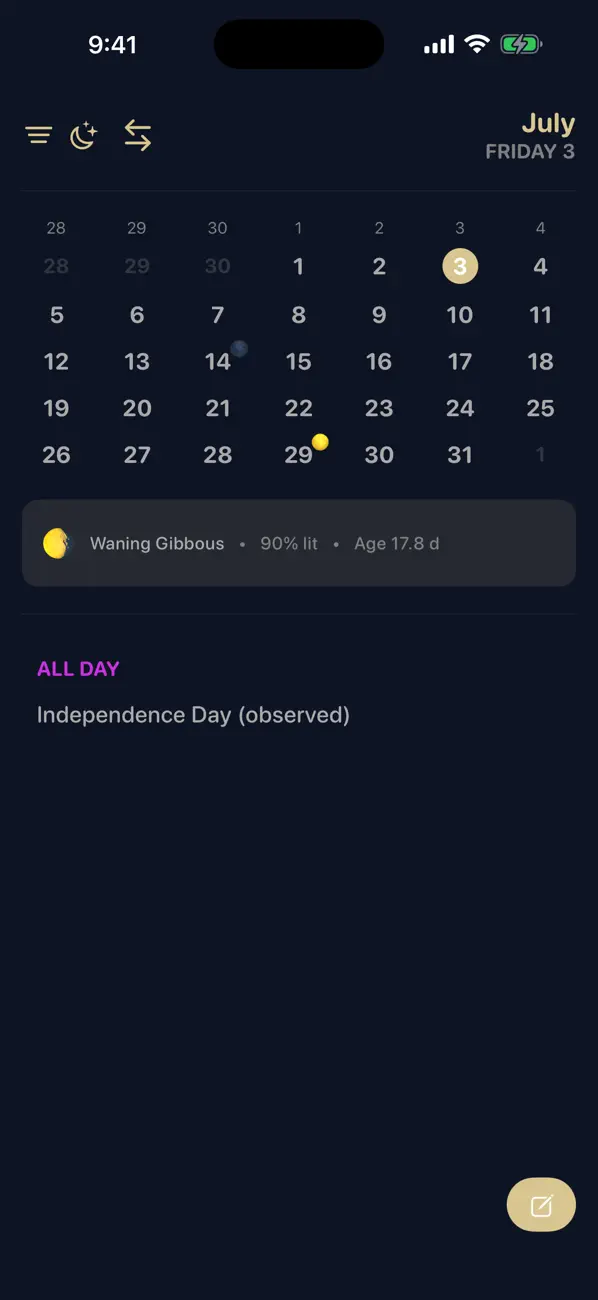
    Open on tonight. Scroll ahead. Put it on the calendar.

    1. 1.

      Open on tonight

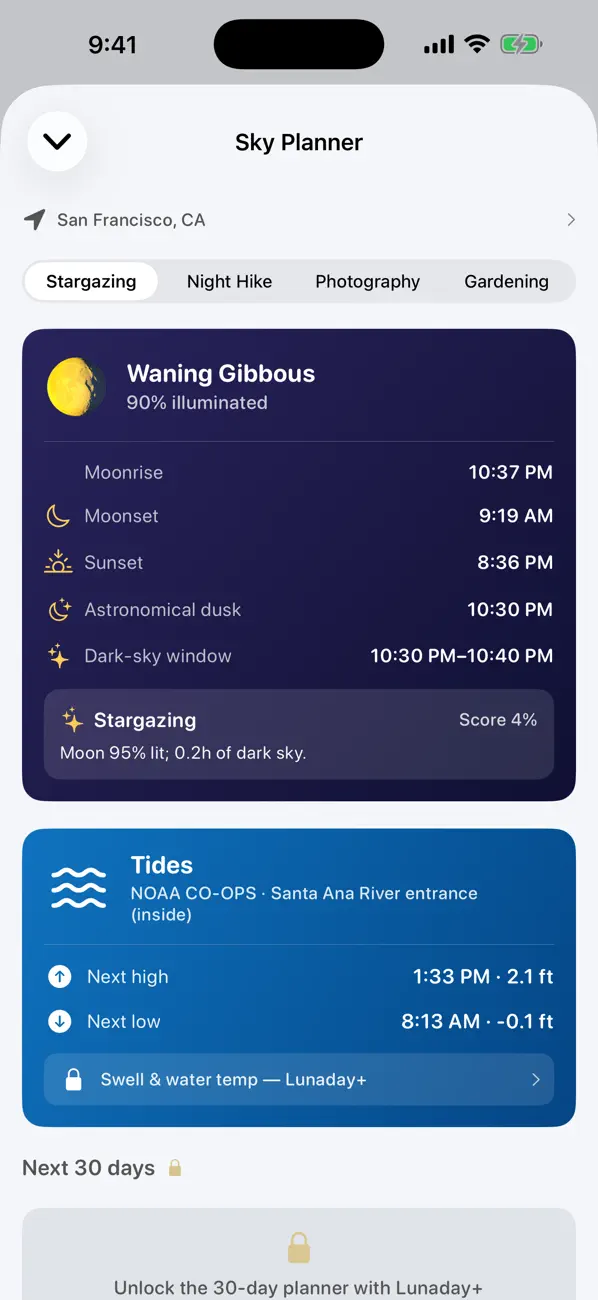
      Tonight's phase, moonrise and moonset, sun times, and the tide at your nearest NOAA station — the sky where you're standing, the moment you open the app.

    2. 2.

      Scroll ahead

      See the phase for any day, weeks out. The dark-sky nights around each new moon are marked, so the good windows for stargazing find you instead of the other way around.

    3. 3.

      Put it on the calendar

      There's a real calendar underneath. Drop an observing session in next to work and life, and let widgets and Siri surface tonight's sky without opening the app.

    At a glance

    Astronomy
    computed on device, offline
    Tides
    nearest NOAA CO-OPS station
    Calendar
    real EventKit · widgets · Siri
    Accounts
    none
    Ads & tracking
    none
    Price
    free · Lunaday+ $9.99 once
  3. 03 · Full — everything, in view

    Written for stargazers. Earned by the water.

    Lunaday is built for stargazers first — the dark-sky calendar is the heart of it — but the tide table earns it a place with fishers, surfers, and anyone who lives by the water. Photographers get moonrise times worth setting an alarm for. Gardeners get the traditional almanac layer, kept clearly to one side and labeled as tradition, not science. And it knows the old names: it can tell you the Wolf Moon from the Sturgeon Moon, the Harvest Moon from the Snow.

    Tonight

    Full Moon over your rooftop. Moonrise 8:42 PM, moonset 5:07 AM, and the sun times bracketing them.

    Tides

    The rise and fall at your NOAA station, high and low marked to the minute, tonight and the days ahead.

    Sky events

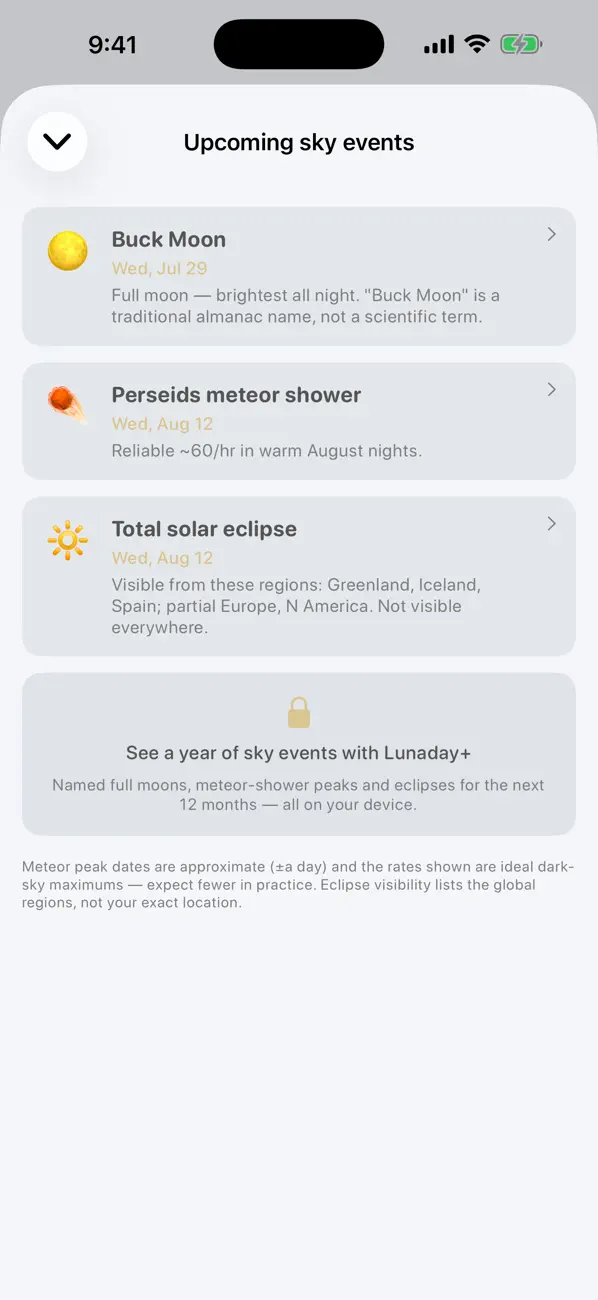
    The year laid out — Wolf Moon, the Perseids, a lunar eclipse — in the list and on the day cards.

    Lunaday is free, and free is genuinely useful: the phase for any day, moonrise and moonset, sun times, and today's tide at your nearest station. A one-time Lunaday+ purchase — $9.99, yours forever, no subscription — opens up the parts you'll plan around.

    What Lunaday+ unlocks

    Sky Planner
    30-day best-night timeline, tap to plan
    Sky events
    a year of full moons, showers & eclipses
    Swell & water temp
    live from the nearest NOAA buoy
    Calendar systems
    16, plus a custom start of week
    Siri Shortcuts
    tonight's sky, hands-free
    Price
    $9.99 once · no subscription
  4. 04 · Waning — privacy & questions

    Quiet by design.

    Privacy here is architecture, not a promise. The astronomy — every phase, rise, set, and dark-sky window — is computed on your iPhone, offline, by a Swift port of the well-known SunCalc algorithms. Lunaday reaches the network at exactly three keyless endpoints, and none of them carries anything about you: NOAA tide stations, NOAA weather buoys for swell, and Apple geocoding to turn a place into a name. No account, no analytics, no tracking, no ads. The privacy policy is short enough to actually read.

    Vitals

    Data collected
    none
    Accounts
    none
    Astronomy
    computed on device, offline
    Network
    NOAA & Apple geocoding, keyless
    Ads & tracking
    none
    Price
    free · Lunaday+ $9.99 once
    Is this astrology?

    No. Lunaday is computed astronomy and public NOAA data — phases, rise and set times, tides — with no predictions of any kind. The traditional almanac layer (full-moon names, folk planting dates) is opt-in and clearly labeled as tradition, kept apart from the numbers.

    Does it work offline?

    Everything astronomical, yes — phases, moonrise and moonset, sun times, and dark-sky windows are all computed on the device. Tides and swell are the exception: those need a connection to reach NOAA.

    Is Lunaday+ a subscription?

    No. Lunaday+ is $9.99 once, yours forever — no subscription, no per-feature fees. Restore Purchases carries it to your other devices. Optional tips are there if you'd like to leave one, but nothing is ever required.

    When does it launch?

    It's in App Review now. This page gets the download button the day it's approved — leave a note on the Support page and I'll tell you when it's live.

    Where do the tide numbers come from?

    NOAA CO-OPS tide stations — the same public data the tide charts use. Pick your station, or let Lunaday use the nearest one to where you are.

    More questions answered on the Support page →

Look up on the right night.

Coming soon to the App Store